
When you brush your teeth and notice an unusual spot or discoloration, it is natural to feel a pang of anxiety. You might immediately wonder, what does a cavity look like? Tooth decay is one of the most common health issues globally, yet many people do not know how to identify it in its early stages. Because cavities do not always cause pain right away, relying solely on how your teeth feel is not enough to protect your smile.
The appearance of a cavity can vary significantly depending on its location and how far it has progressed. While most people picture a dark, gaping hole, the reality is that early decay is often much more subtle. You might be asking, what does the start of a cavity look like, or perhaps you are concerned about a specific area and wondering what a cavity looks like on a molar.
Knowing the visual signs of tooth decay can help you catch it early, when treatment is simplest and most effective. Let’s look at the different stages of decay, answer common questions like what a small cavity looks like, and discuss how the expert team at SoCal Sleep Dentistry can restore your oral health with professional dental fillings.
What Does a Cavity Look Like When it First Starts?
What does a cavity look like when it first starts? You might be surprised to find that it is not black or brown. The very first sign of tooth decay is often a small, chalky white spot on the surface of the enamel. This white spot indicates an area of demineralization, where acids produced by plaque bacteria have begun to dissolve the minerals in your tooth.
At this early stage, the enamel is weakened but not yet broken. Because there is no actual hole or “cavity” yet, this stage of decay is often reversible. With improved oral hygiene and professional fluoride treatments, the enamel can remineralize and harden, stopping the decay process in its tracks.
However, these white spots can be difficult to spot on your own, especially if they are located between the teeth or near the gumline. This is why regular dental check-ups are so important. A dentist can easily identify these early warning signs during a routine examination and intervene before the decay progresses further.
What Brown or Black Spots on Your Teeth Mean
If the demineralization process continues unchecked, the enamel will eventually break down, and a true cavity will form. As the decay progresses into the softer, underlying layer of the tooth called the dentin, the appearance of the cavity changes significantly.
So, what does a small cavity look like at this stage? It typically appears as a light brown or dark brown spot on the tooth. The discoloration occurs because the porous, decayed dentin easily absorbs stains from food, drinks, and the bacteria themselves. The spot may look like a small shadow or a distinct, discolored pit on the surface of the tooth.
When the decay reaches the dentin, you may also start to experience symptoms like tooth sensitivity to hot, cold, or sweet foods. The dentin contains microscopic tubules that lead directly to the nerve of the tooth, making it much more sensitive than the protective enamel layer.
What Does a Cavity Look Like on a Molar?
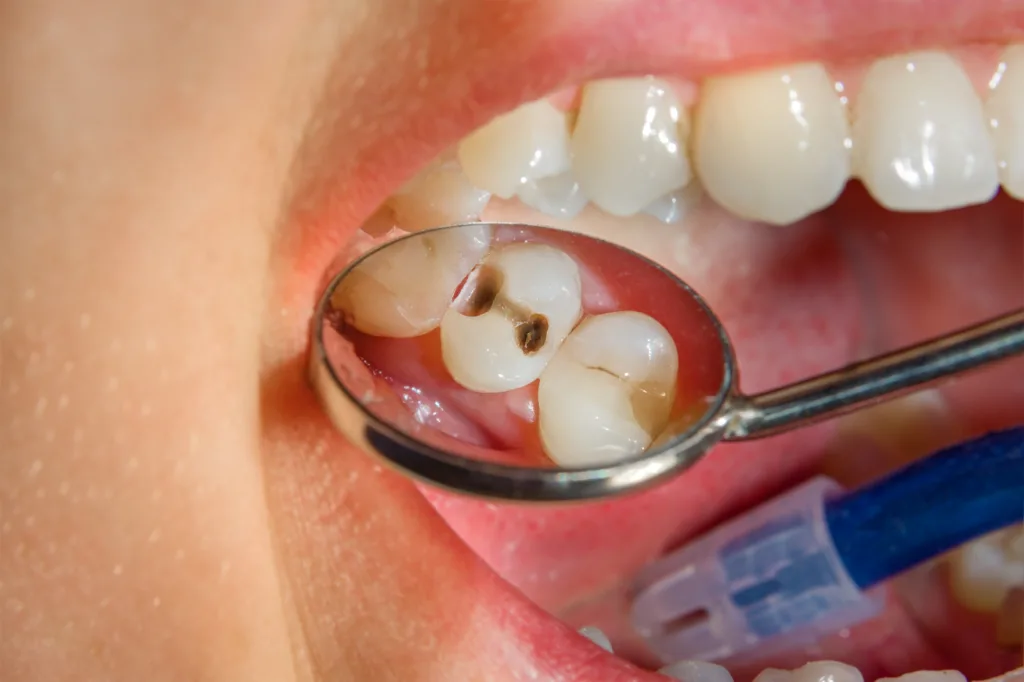
Molars, the large, flat teeth at the back of your mouth, are particularly susceptible to cavities. Their chewing surfaces are covered in deep pits and fissures (grooves) that easily trap food particles and plaque. Because these grooves are often narrower than a single toothbrush bristle, they can be incredibly difficult to keep clean.
You should look for dark staining within these grooves. The decay often starts as a thin, dark line or a small brown dot deep within a fissure. Over time, as the cavity grows, the dark area will expand and may eventually form a visible hole.
Because molars are located at the back of the mouth, it can be challenging to see these cavities yourself. Often, a dentist will use specialized tools to gently feel the grooves of your molars during an exam. If the tool catches in a groove, it signals that the enamel has softened and a cavity is present.
What Does A Cavity Look Like If Left Untreated?
If a cavity is left untreated, the bacteria will continue to eat away at the tooth structure, creating a larger and deeper hole. At this advanced stage, you will likely see a distinct, dark hole or pit in the tooth.
The color of the decayed area may range from dark brown to black. As the structural integrity of the tooth is compromised, you may also notice that the tooth looks chipped, fractured, or unusually worn. In severe cases, a large portion of the tooth may break away entirely.
Advanced decay is usually accompanied by significant pain, especially when biting down or consuming hot or cold foods. The pain may become constant or throbbing, indicating that the decay has reached the innermost part of the tooth, known as the pulp.
When Decay Reaches the Pulp
The pulp is the living tissue inside the tooth that contains nerves and blood vessels. When a cavity progresses deep enough to reach the pulp, the bacteria cause a severe infection and inflammation. This is a painful and serious condition that requires immediate dental attention.
At this stage, the tooth may look severely discolored, often appearing dark gray or black from the inside out. You may also notice swelling in the surrounding gums or a pimple-like bump on the gumline, which is a sign of an abscess (a pocket of pus caused by the infection).
When the pulp is infected, a simple filling is no longer sufficient to save the tooth. Instead, a root canal procedure is necessary. During a root canal, the dentist removes the infected pulp, cleans and disinfects the inside of the tooth, and seals it to prevent further infection. Following the procedure, the tooth is typically restored with a crown to protect it and restore its function.
Your Visual Guide to Cavities
Preventing Cavities Before They Start
While knowing what a cavity looks like is important, preventing them from forming in the first place is always the best approach. Maintaining a robust daily oral hygiene routine is your first line of defense against tooth decay.
Brush your teeth at least twice a day using a fluoride toothpaste, and floss daily to remove plaque from between your teeth where your toothbrush cannot reach. Limiting your intake of sugary and acidic foods and drinks will also help protect your enamel from acid attacks.
Most importantly, do not skip your regular dental check-ups and professional cleanings. These visits allow your dentist to monitor your oral health, identify early signs of demineralization, and provide preventive treatments like fluoride applications or dental sealants to keep your teeth strong and cavity-free.
Stop Cavities and Book a Dental Check Up at SoCal Sleep
If you have noticed a suspicious spot on your tooth, are experiencing sensitivity, or simply want to maintain your smile’s health and cavity-free status, the team at SoCal Sleep Dentistry is here to help. We provide thorough dental exams and expert restorative care in a comfortable, welcoming environment.
Our experienced professionals will carefully evaluate your teeth, answer any questions you have about your oral health, and recommend the best treatment options to protect your smile. Contact us today to schedule your appointment.
Frequently Asked Questions
What does a cavity look like when it first starts?
The earliest sign of a cavity is often a chalky white spot on the enamel, indicating an area of demineralization where the tooth is losing minerals.
What does a small cavity look like?
As decay progresses into the dentin, a small cavity typically appears as a light brown or dark brown spot, shadow, or small pit on the surface of the tooth.
What does a cavity look like on a molar?
On a molar, a cavity often starts as a dark, stained line or a small brown dot deep within the pits and grooves on the chewing surface of the tooth.
Can a cavity heal itself?
In its very earliest stage (the white spot stage), demineralization can be reversed with improved oral hygiene and fluoride. However, once a physical hole or cavity has formed, it cannot heal itself and requires a professional filling.
How do I know if I need a root canal instead of a filling?
If a cavity is left untreated and the decay reaches the inner pulp of the tooth, causing severe pain, infection, or an abscess, a root canal is necessary to save the tooth. A filling is only sufficient when the decay is confined to the outer layers (enamel and dentin).