
Tooth decay is a very common problem. Almost everyone will get a cavity at some point in their life. But many people do not know they have one until their tooth starts to hurt. By the time you feel pain, the decay has usually spread deep into the tooth. Catching decay early is the best way to keep your smile healthy. That is why it is so helpful to know what do cavities look like before they cause trouble.
Checking your teeth in the mirror can help you spot early signs of trouble. A cavity does not always look like a big black hole. In fact, early decay can be very hard to see. At SoCal Sleep Dentistry, we want to help you understand the signs of tooth decay. We use advanced tools to find cavities when they are still very small. Let us look at the different stages of decay so you know what to watch out for.
What Does the Start of a Cavity Look Like?
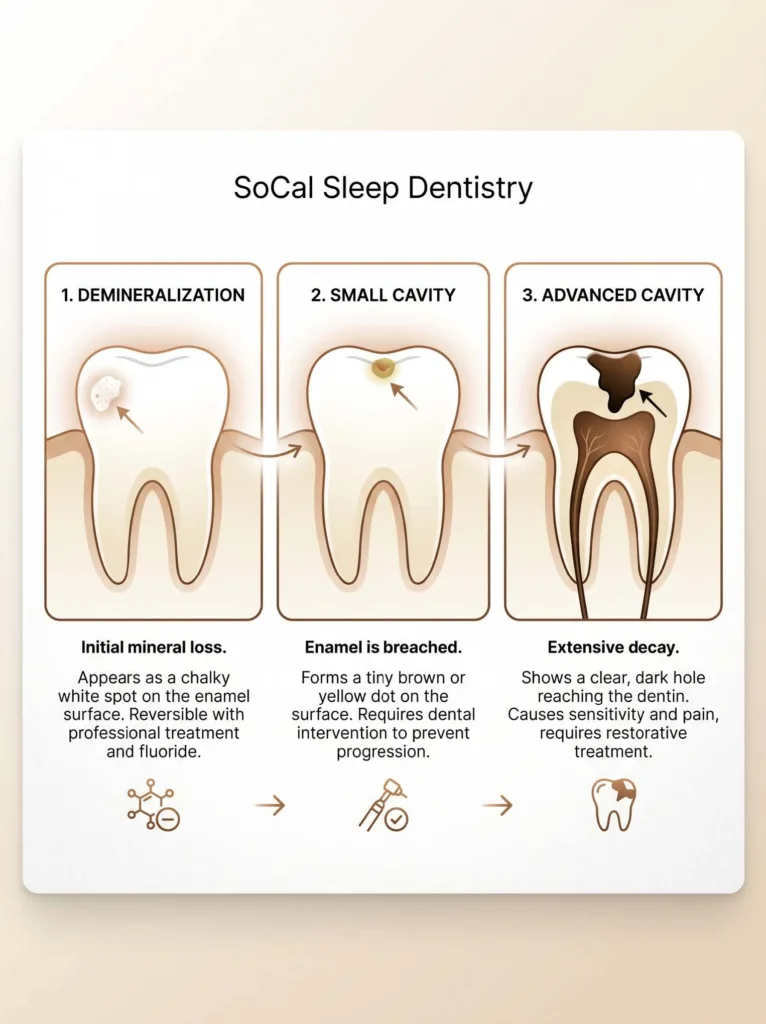
The very first stage of a cavity is called demineralization. This happens when the acids from plaque start to weaken your tooth enamel. So, what does the start of a cavity look like? It usually looks like a small, chalky white spot on your tooth.
These white spots are very easy to miss. They do not hurt, and they often form in places that are hard to see, like between your teeth or near the gumline. If you notice a chalky white spot, it is a warning sign. The good news is that at this stage, the decay can sometimes be stopped or even reversed. Good brushing, flossing, and fluoride treatments can help harden the enamel again before a real hole forms.
What Do Small Cavities Look Like?
If the white spot is not treated, the enamel will continue to break down. Eventually, a small hole will form in the surface of the tooth. This is when the decay officially becomes a cavity. So, what do small cavities look like? They often look like tiny brown or yellow dots on the tooth.
You might see these spots on the chewing surfaces of your back teeth. The back teeth have deep grooves where food and plaque easily get stuck. A small cavity might also look like a faint shadow under the surface of the enamel. At this stage, you still might not feel any pain. But the decay will not stop on its own. You need to visit the dentist to get the small hole cleaned out and filled.
What Does a Cavity Look Like on a Molar?
Your molars are the large teeth at the back of your mouth. They do most of the heavy chewing, and they are the most common place to get cavities. If you are wondering what does a cavity look like on a molar, you need to look closely at the deep pits and grooves on the top of the tooth.
A cavity on a molar often starts as a dark stain in one of these grooves. It might look like a thin brown or black line. As the decay gets worse, the line will get wider and deeper. You might even be able to feel a small dip or hole if you run your tongue over it. Because molars are hard to see and hard to clean, cavities here can grow quickly. Regular dental checkups are the best way to catch them early.
What Do Cavities Look Like on Teeth When They Are Advanced?
If a cavity is left untreated for a long time, it will grow larger and deeper. It will eat through the hard enamel and reach the softer layer underneath, called the dentin. When decay reaches the dentin, it spreads much faster. So, what do cavities look like on teeth when they are advanced?
An advanced cavity is usually very easy to see. It will look like a clear, dark hole in the tooth. The hole might be brown, black, or even dark grey. The whole tooth might start to look dark or discolored. At this stage, you will probably feel pain, especially when you eat sweet, hot, or cold foods. You might also feel a sharp pain when you bite down. An advanced cavity needs to be treated right away to save the tooth.
What Do Cavities Look Like on an Xray?
Sometimes, a cavity forms between two teeth where you cannot see it in the mirror. Even your dentist might not be able to see it just by looking in your mouth. That is why dental x-rays are so important. But what do cavities look like on an xray?
On an x-ray, your healthy tooth enamel looks solid and white. A cavity looks like a dark shadow or a dark spot on the white tooth. The x-ray shows the dentist exactly how deep the decay has gone. It helps them see if the cavity has reached the nerve of the tooth. X-rays are a vital tool for finding hidden decay before it causes serious pain or damage.
The Dangers of Ignoring a Cavity
Ignoring a cavity is never a good idea. Even if it does not hurt right now, the decay is still spreading. If the decay reaches the soft center of the tooth, called the pulp, it can cause a very painful infection.
When the pulp is infected, a simple filling is no longer enough. You will likely need a root canal to save the tooth. If the infection is too severe, the tooth might even need to be pulled out completely. Treating a cavity early is much easier, faster, and less expensive than waiting until it becomes a major problem.
How We Treat Cavities at SoCal Sleep Dentistry
If you think you might have a cavity, do not panic. Treating tooth decay is a very common and simple procedure. At SoCal Sleep Dentistry, we use tooth-colored composite fillings to repair cavities. These fillings blend in perfectly with your natural teeth, so no one will even know you had a cavity.
The process is quick and comfortable. We will numb the area so you do not feel any pain. Then, we will carefully remove the decayed part of the tooth and clean the area. Finally, we will place the filling material and shape it to match your tooth. If you feel nervous about getting a filling, we offer different sedation options to help you relax.
Preventing Future Cavities
The best way to deal with cavities is to prevent them from happening in the first place. Good oral hygiene is your best defense. Brush your teeth twice a day with fluoride toothpaste and floss every single day. This removes the sticky plaque that causes decay.
You should also limit sugary snacks and drinks. Sugar feeds the bacteria that make the acids that destroy your enamel. Drinking plenty of water helps wash away food particles and keeps your mouth healthy. Most importantly, visit your dentist for regular checkups and cleanings. We can spot the early signs of decay and help you keep your smile strong and cavity-free.
Schedule Your Dental Checkup Today
If you see a dark spot on your tooth or feel any pain, it is time to see the dentist. Catching a cavity early makes treatment much easier. Contact SoCal Sleep Dentistry today to schedule an exam. We will check your teeth carefully and help you get your healthy smile back.
Frequently Asked Questions
What do cavities look like?
Cavities can look like chalky white spots, tiny brown or yellow dots, or dark holes in the tooth. The appearance changes depending on how advanced the decay is.
Can a cavity go away on its own?
No, a cavity will not heal on its own. Only the very first stage of decay, a white spot, can sometimes be reversed with good hygiene and fluoride. Once a hole forms, it must be filled by a dentist.
Do all cavities hurt?
No, early cavities usually do not hurt at all. You typically only feel pain when the decay reaches the deeper, more sensitive layers of the tooth.
How long does it take for a cavity to form?
It can take months or even years for a cavity to form. The speed depends on your diet, your oral hygiene habits, and the strength of your tooth enamel.
Are tooth-colored fillings better than silver ones?
Tooth-colored composite fillings are very popular because they look natural and bond well to the tooth. They are a great choice for most cavities, especially those that are visible when you smile. They are also free of mercury, which many patients prefer.